Korean restaurant mastery comes down to one thing: knowing the loop before you walk in. Order the right way, handle the table correctly, eat the BBQ with actual confidence — and the whole experience stops being a guessing game. This post pulls together everything from the first three parts of this series into a single, practical playbook you can use on your next visit.
I’ve watched a lot of first-timers freeze at Korean restaurant doors. Not because the food is hard, but because nobody explained the rituals around it — the call button, the shared plates, the scissors at the grill. Once you know those, you stop hesitating and start actually enjoying the meal. That’s the whole point of this series, and this is where it pays off.
The confidence playbook: step by step
Here’s the full loop, from sitting down to paying and leaving. Walk through this once and it’ll feel automatic the second time.
| Step | What happens | What to do |
|---|---|---|
| 1. Sit down | Banchan (small side dishes) arrive automatically | Don’t order them — they’re free and refillable. Taste everything. |
| 2. Get settled | Check the table setup | Metal chopsticks + long spoon (for rice and stew). Utensils often live in a side drawer, not on the table. |
| 3. Water | Often self-serve | Look for a dispenser or kettle on the counter. Help yourself. |
| 4. Call the server | No one hovers waiting | Press the call button on the table, or say “yogiyo!” (여기요). This is polite, not rude. |
| 5. Order | Point at the menu and say “igeo juseyo” (이거 주세요) | For a first visit: one main + rice + a side if you want. Stews/BBQ are often listed for two or more. |
| 6. Manage spice | Worried about heat? | Say “deol maewo juseyo” (덜 매워 주세요) — “less spicy, please.” Staff hear it constantly. |
| 7. Eat | Banchan come alongside everything | Spoon for rice and stew, chopsticks for everything else. Graze across the table. |
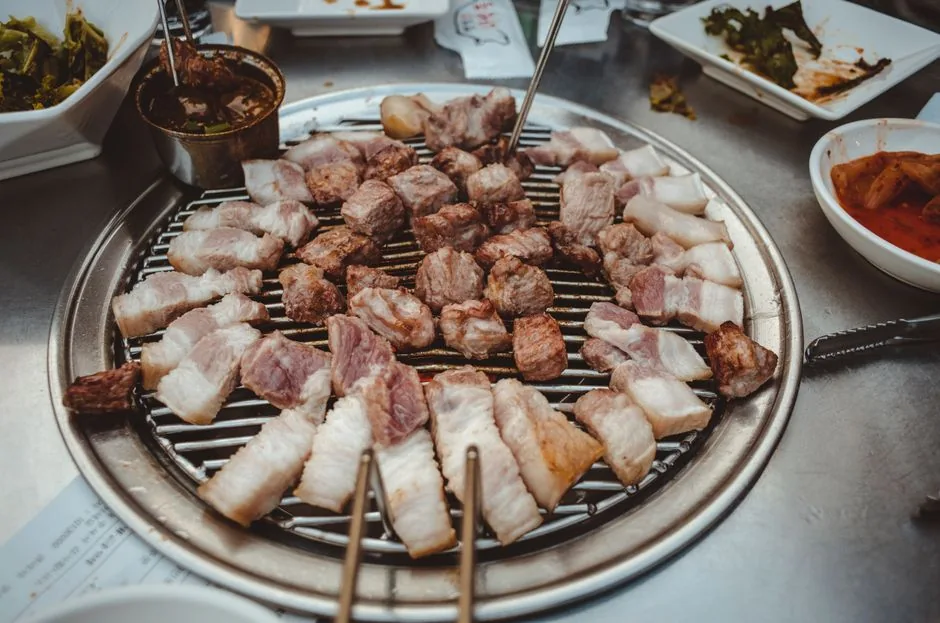
| 8. Korean BBQ specifically | Grill in the middle of the table | Small batches, flip thin cuts often, let marinated cuts caramelize. Make ssam wraps small enough for one bite. |
| 9. Pay | Don’t wait for a check at the table | Walk to the counter by the door and pay on the way out. |
| 10. Tip | Don’t | Tipping isn’t part of Korean dining culture. Leave a good review instead. |
What to order on your first visit
You don’t need to memorize a whole menu. A solid first-visit order:
- Bulgogi (if you want a mild, crowd-pleasing main) or samgyeopsal (pork belly, if you’re doing BBQ — it’s the most forgiving cut at the grill)
- A bowl of rice — always, for any meal
- Japchae as a shared side if you want something extra (sweet potato noodles, completely mild)
- A little kimchi from the banchan spread, to test the waters
That covers the core of what Korean food actually tastes like — sweet, savory, a little fermented — without anything intimidating.
The Korean BBQ run-down
BBQ gets its own section because it’s the meal most newcomers walk into without knowing the moves. Pull from how to eat Korean BBQ:
- Order samgyeopsal (pork belly). Safe, popular, hard to ruin.
- Grill in small batches. Don’t crowd the grate.
- Build your ssam wrap: lettuce leaf, one piece of meat, a dab of ssamjang paste, one topping max. Fold and eat in one bite. Overstuffing is the single most common mistake.
- Offer the first cooked pieces to older people at the table if there are any — a small habit that earns you a lot of goodwill.
Quick do’s and don’ts
| Do | Don’t |
|---|---|
| Refill your own banchan by asking “igeo deo juseyo” | Leave cash as a tip — it confuses staff |
| Call the server with “yogiyo!” or the table button | Wait around for someone to check on you |
| Pay at the counter by the door | Expect a check at the table |
| Eat ssam wraps in one bite | Overstuff the wrap and try to take two bites |
| Order bulgogi or samgyeopsal for a safe first try | Order the spiciest thing on the menu just to prove a point |
| Ask for food milder with “deol maewo juseyo” | Suffer through a dish that’s too hot to enjoy |
| Use the long spoon for rice and stew | Use chopsticks for everything and struggle |
A few phrases that carry you through almost any meal
You don’t need to learn Korean to eat well at a Korean restaurant. But these five phrases cover basically every situation:
- “Yogiyo!” (여기요) — “over here,” to call the server
- “Igeo juseyo” (이거 주세요) — “this one, please,” while pointing
- “Deol maewo juseyo” (덜 매워 주세요) — “less spicy, please”
- “Mul juseyo” (물 주세요) — “water, please”
- “Mat-isseoyo” (맛있어요) — “it’s delicious”
That last one is always appreciated. Use it freely.
The series that got you here
If you want to go back and read any part in more detail:
- Korean food for beginners: where to start and what to work up to — the full introduction to the food itself, the spice situation, and what to order first
- How to order at a Korean restaurant without the stress — banchan, call buttons, paying at the counter, and the table setup
- How to eat Korean BBQ without looking lost — the grill, ssam wraps, samgyeopsal, and the etiquette that earns you points
The real trick isn’t memorizing everything above. It’s doing it once. Do the loop once — walk in, press the button, order bulgogi, ask for a refill on the banchan you liked, pay at the counter on your way out — and none of it will feel foreign again. The second visit is always better than the first.
For more on Korean dining customs that carry you beyond the restaurant itself, Korean dining etiquette is worth a quick read too.
FAQ
What’s the most important thing to know before your first Korean restaurant visit? That the small plates (banchan) are free and refillable, and that you pay at the counter by the door — not at the table. Get those two right and everything else is manageable.
Is it rude to ask for food less spicy? Not at all. “Deol maewo juseyo” is completely normal and staff hear it constantly. Most restaurants can adjust the heat on stews and sauced dishes without any trouble.
Do I have to grill my own food at Korean BBQ? Not always — some restaurants grill for you. If you’re cooking yourself, just watch your batches, flip thin cuts often, and let marinated cuts caramelize before turning. The staff will usually show you how the first time if you look uncertain.
What if I can’t use metal chopsticks? Ask for a fork or just use the long spoon for everything — it works fine for rice, stew, and most dishes. Nobody will give you a hard time. Most Korean restaurants have forks if you need one.
About the author — Jae is a Seoul-based writer at K-Culture Log, helping newcomers get into Korean culture without the overwhelm.